
Base Plate (Align & Contact)
- Spring-loaded contact pins
- Large capture area for landing tolerance
- Weather-resistant outdoor design
- Gold-plated for high-current transfer
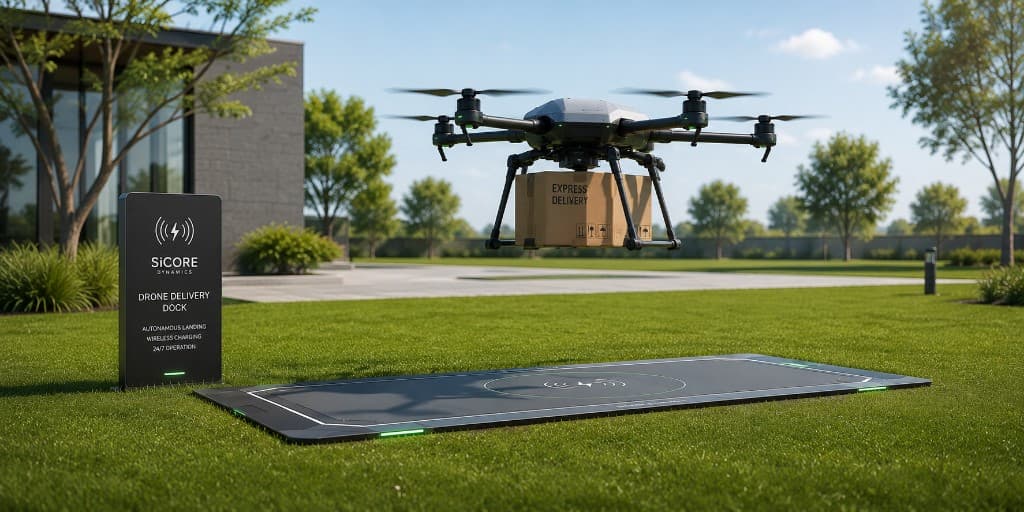
Enable fully autonomous drone operations with intelligent wireless charging. Our low-profile charging dock allows drones to land, recharge, and redeploy automatically without exposed electrical contacts, providing reliable power transfer in outdoor environments for parcel delivery, infrastructure inspection, and security patrol.
24/7
Multi-shift fleet utilization
0 pins
No mechanical connector wear
Weatherproof
Stands all weather
Fleet
Standardized charging zones
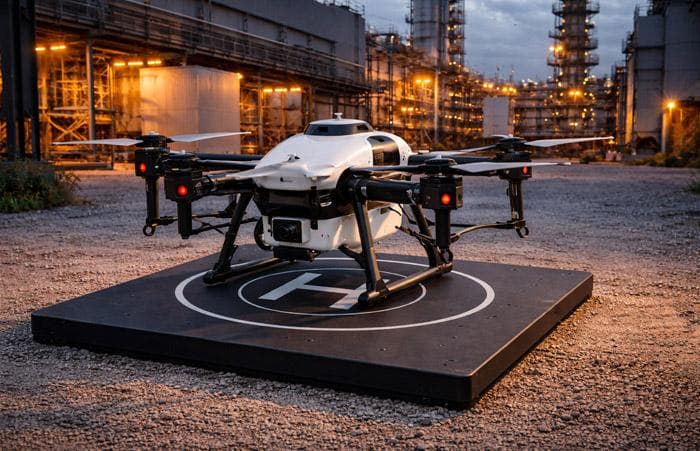
Autonomous drone fleets are measured by mission availability—the percentage of time aircraft spend performing missions rather than waiting for charging, battery replacement, or maintenance. Conventional contact-based charging systems rely on exposed electrical contacts that require precise landing alignment and regular cleaning, especially in outdoor environments.
Every landing introduces potential failure points: contaminated contacts, corrosion from rain or humidity, dust accumulation, and mechanical wear that can interrupt charging or delay the next flight. Across large drone fleets, these issues reduce operational efficiency and increase maintenance costs.
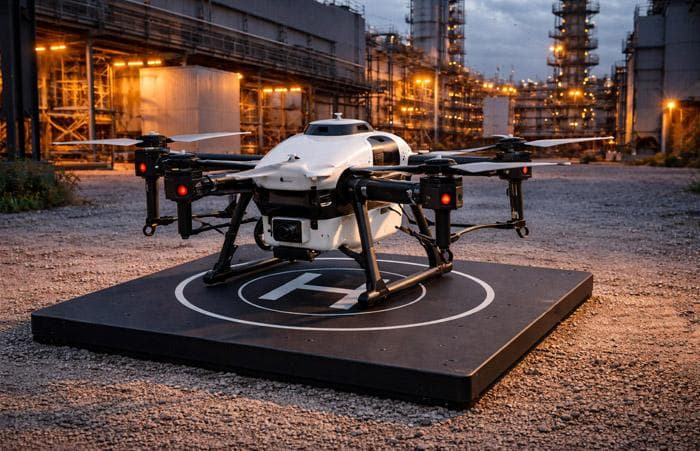
Autonomous drones return to a designated charging pad after completing each mission or when battery capacity reaches a predefined threshold. Precision landing technology guides the aircraft onto an ultra-low-profile wireless charging pad, eliminating exposed electrical contacts and manual charging procedures.
Charging performance, battery condition, and power transfer are continuously monitored to maximize efficiency and operational safety. Once charging is complete, the drone automatically launches its next mission without operator intervention.
At scale, wireless charging enables fully autonomous drone fleets by replacing manual battery handling and connector maintenance with intelligent, software-managed energy infrastructure—unlocking continuous operations for parcel delivery, infrastructure inspection, emergency response, and security patrol.
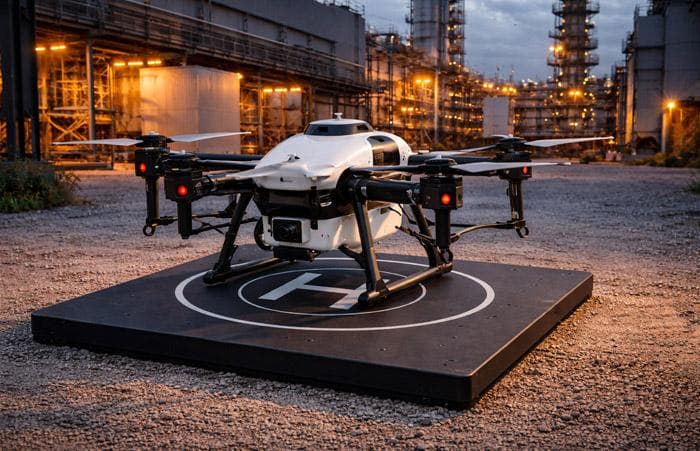
Wireless opportunity charging keeps autonomous drone fleets flying without manual battery swaps or connector docking at every energy stop.
Drone
Charging Dock
Wireless Charging
Redeploy Mission
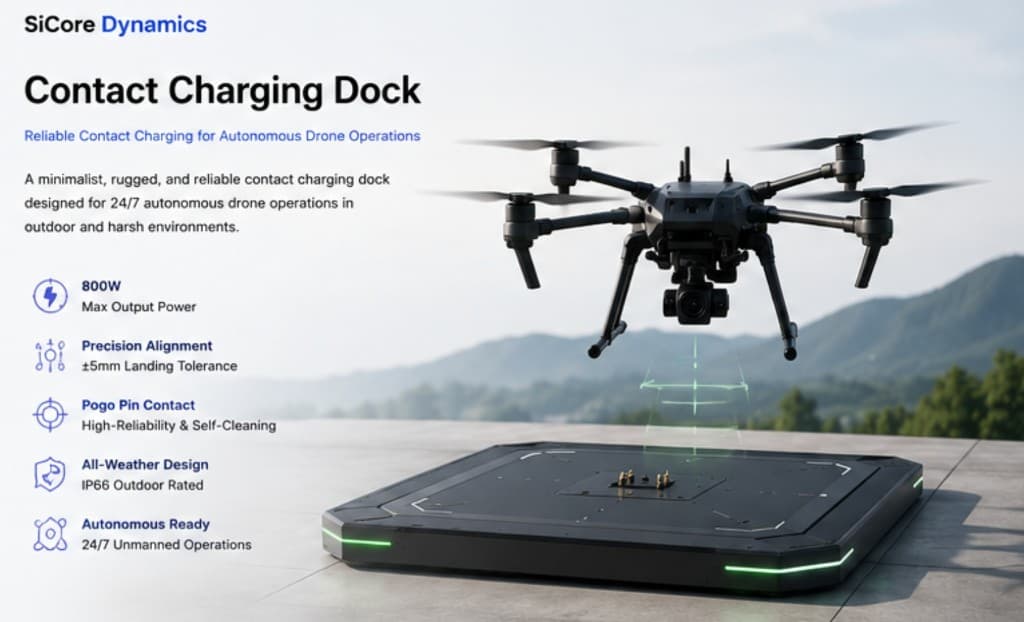
A contact charging solution for autonomous drone fleets that delivers high-efficiency, fast charging and reliable autonomous operation.
Precision Landing
RTK + AI navigation landing achieves ±10–30 cm precision for reliable contact.
Automatic Contact
Solid contact pins engage automatically for reliable power transmission.
High Power Charging
800W–1500W charging with intelligent power management and control.
Mission Continuity
Fast turnaround between missions without manual battery swap.
01
Mission Return
Drones return to the dock after completing a mission or when the battery is low.
02
Precision Approach
RTK + visual approach aligns the drone to the dock platform.
03
Precision Landing
Landing accuracy of ±10–30 cm ensures reliable contact engagement.
04
Contact Engagement
Latching mechanisms lock for a solid high-current power connection.
05
High Power Charging
Rapid 800–1500W DC charging with intelligent BMS and health monitoring.
06
Mission Redeployment
After full charge, the drone is ready for the next mission immediately.
Landing Platform
Robust 1200 mm square surface for autonomous landing.
Power Electronics
Integrated AC–DC power modules for fast charging.
Control Electronics
Intelligent MCU for communication and safety.
Thermal Management
Forced air cooling for continuous high-power operation.
| Max Power | 800W–1500W |
|---|---|
| Input Voltage | 85–264VAC, 50/60 Hz |
| Output Voltage | 40–60VDC (Configurable) |
| Efficiency | > 96% |
| Charging Time | 45–60 mins (Typical 22Ah) |
| Protection | Surge, OCP, OVP, OTP |
| IP Rating | IP55 / IP66 |
| Dimensions | 1200 × 1200 × 250 mm |
| Weight | ~110 kg |
Wireless Charging
Contact Charging
Both charging architectures support autonomous drone operations.
SiCore Dynamics develops and integrates both technologies to match different mission profiles and deployment requirements.
Contactless charging removes pin wear and alignment failures, enabling opportunity charging along routes and higher fleet utilization.
Vehicles receive power during short idle periods at route endpoints or queue lanes without manual connector handling or precision mechanical docking.
Yes. Standardized transmitter pads support fleet-wide charging zones configured through facility layout and fleet management software.
SiCore products from 200W mobile platforms to 3000W fleet infrastructure cover light AMRs through heavy-load logistics vehicles.
Magnetic coupling tolerates positional variation far beyond mechanical pin engagement, reducing failed docking events.
Yes. SiCore supports multi-shift, high-throughput logistics with reliable charging stations distributed along operational corridors.
Talk to SiCore Dynamics about wireless and contact dock architecture, power class selection, and OEM integration for UAV delivery, inspection, and patrol programs.